

Barista Course Melbourne | Get Barista Certification with Australian Barista School

After much deliberation, I finally took the plunge and enrolled in a barista school. Melbourne, the coffee capital of the world, seemed like the perfect backdrop for my coffee education. Initially, I had my sights set on the prestigious Melbourne Coffee Academy, but its hefty price tag made me decide to explore other options. I found a more budget-friendly at the Australian Barista School (ABS), nestled within the CBD College.
Australian Barista School
Australian Barista School is a premier institution offering comprehensive coffee training and classes across multiple locations including Adelaide, Melbourne, Sydney, Brisbane, and Newcastle. The school is a Registered Training Organisation (RTO No. 91399) founded by a team of passionate coffee industry professionals, including roaster and espresso bar owners.
Barista Course Rate
I booked the Nationally Recognised Barista 5-hour training on the ABS website, shelling out $132 (AUD 199) in the process. The course offered three hours of comprehensive barista basics training, followed by an additional two hours dedicated to latte art.
Barista Basic
On the day of my training, I stepped out of the dark, chilly morning around 6 a.m. to catch the tram. As I approached Hood Street, a passing tram whisked by. Should I sprint to catch it? I pondered briefly and thought I wouldn’t make it so I just waited for the next one.
Minutes turned into an agonizing ten, and a flicker of anxiety began to gnaw at me. The journey to the city stretched over an hour, and I couldn’t afford to be late. Finally, the tram arrived, and I hopped on.
The school is located along Swanson St. in Melbourne CBD. Ten minutes past the scheduled class, I sheepishly entered the class, thankful that the session had just started. Inside, the room buzzed with activity with eight eager students, myself included, and two instructors. The head instructor was Siva and by his side stood an assistant instructor, a statuesque young Australian woman whose name eluded me. But for easy reference in the telling of this story, let’s call her Lily.
Within the room, a cluster of commercial-grade espresso machines dominated the space, boasting dual group heads and paired steam wands. I found myself paired with an Australian fellow, not much taller than 5’6″, who made a valiant attempt to spark conversation. But my mind was busy and was in no mood to socialize so my responses remained curt.
Each student was given two sheets of paper; a white paper with prints on each side and a green laminated one. The white sheet contains technical information about coffee and a list of the different kinds of coffee beverages. We were able to keep this sheet, but the green one had to be returned to the instructors after the class.
So allow me to share the key things that I learned from this workshop.
All about Espresso
| Espresso | Water | Compaction | Coffee |
| Single | 30 ml | 18 kg | 7 gm |
| Double | 60 ml | 18 kg | 14 gm |
| Single ristretto | 20 ml | 18 kg | 7 gm |
| Double ristretto | 40 ml | 18 kg | 14 gm |
Baristas need to keep a dose of 7 gm or 14 gm of coffee and a compaction of 18kg.
Since the grind or particle size cannot be kept constant, the Golden Rule is 25-30 sec pour for a 30 ml shot.
You need to adjust the Grind due to humidity:
- High humidity: Coffee slows down
- Low humidity: Coffee speeds up
Visual signs of a good espresso
- Infusion time: approximately 4 seconds of nothing
- Thickness: should be as thick as a strand of cooked spaghetti
- Consistent flow: espresso should pour consistently with no bubbles or bounces
- Golden crema: a nice, thick, rich layer of crema that should be golden/caramel in color
Under-extracted coffee: less than 25 seconds, results in a weak-tasting, watery, and sour coffee. This is due to a coarse coffee ground.
Over-extracted coffee: more than 30 seconds, results in a burnt and bitter coffee. This is due to a fine coffee ground.
Tip: Time your coffee every 30 mins as the changes in the humidity inside the cafe affect the timing of the coffee extraction. Use a collar to make any changes, coarser or finer to maintain the 25-30 second rule.
Milk frothing
The final serving temperature for dairy and non-dairy milk is as follows:
- Normal: 65°C
- Hot: 70°C
- Not too hot: 55°C
Dairy milk (full cream, skim, light) Turn the steam wand off at 5°C before the final serving temperature.
Non-dairy milk (soy, almond, coconut, rice, and all other non-dairy milk) Turn the steam wand off at 15 °C before the final serving temperature.
Hygiene and maintenance
- You must have at least 2 different-colored cloth (leave one on the top tray, the other on the bench) to avoid cross-contamination.
- Clean and purge the steam wand immediately after milk frothing
- Backwash the espresso machine daily and clean the drip tray
- Left-over coffee needs to be placed in a vacuum-sealed container and the hopper needs to be washed
- Coffee machines and grinders need to be polished using a micro-fiber cloth and a window cleaner
- Check pressure gauges. If the pressure gauges do not read 1 or 9 bar, inform your supervisor and arrange for a machine technician to fix them
- Steam pressure for milk: 1 bar
- Water pressure for coffee: 9 bar
Coffee beverages
We learned about the different types of coffee drinks and were taught how to make latte, flat white, cappuccino, mocha, macchiato, and short black.
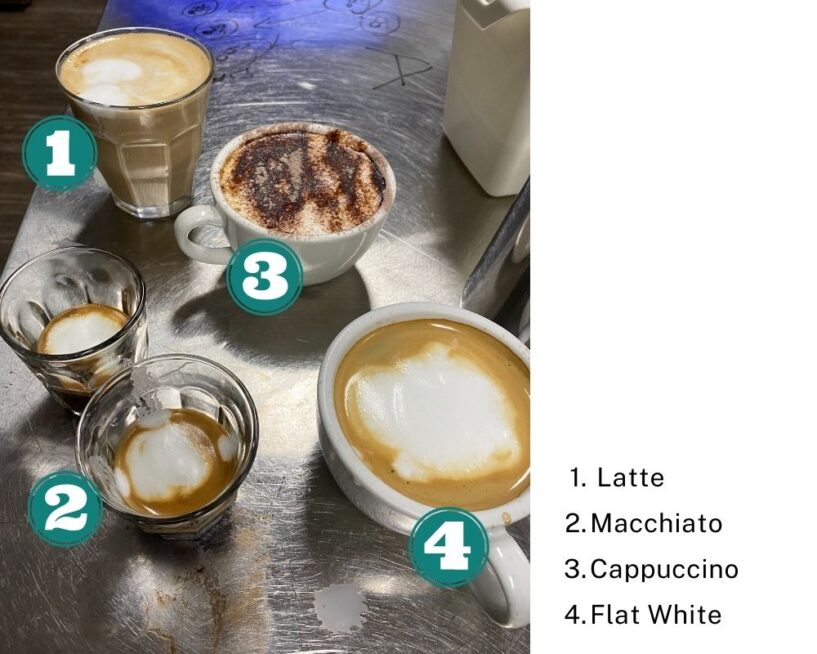
| Coffee | Abbreviation | Served in | Description |
| Cappuccino | C | Ceramic cup | A shot of espresso with creamy, textured milk on top, extending over the rim to create a “dome,” sprinkled with chocolate powder on top |
| Cafe Latte | L | Glass | A shot of espresso with creamy, textured milk poured on top. The creamy froth extends down the glass about 10 mm |
| Flat White | FW | Ceramic cup | An Australian invention, which is a shot of espresso with about 2–3 mm of creamy froth on top |
| Cafe Mocha | M | Ceramic cup | One tablespoon of chocolate powder dissolved in a shot of espresso. It has creamy, textured milk on top just like in a cappuccino, with a sprinkle of chocolate powder |
| Espresso shot or Short Black | E or SB | Small cup or glass | A single shot of espresso (30 ml) |
| Double Espresso or Doppio | D | Shot glass or doppio glass | Double shots of espresso shots (60ml) |
| Ristretto | R | Small cup or glass | Two-thirds of a shot of espresso (the first, 20 ml) the purest part of an espresso |
| Double Ristretto | DR | Shot glass or doppio glass | Double ristretto shots (40 ml) |
| Long Black | LB | Ceramic cup | Half a cup of water with double espresso shots |
| Short Macchiato | SM | Shot glass | A shot of espresso with a dash of milk and one teaspoon of creamy froth spooned on top |
| Long Macchiato | LM | Ceramic cup | A long black with a dash of milk and two tablespoons of creamy froth spooned o top |
| Piccolo Latte | P | Short macchiato glass | A ristretto shot with textured milk up to the top, and about 3–4mm of creamy froth on the surface |
| Hot Chocolate | HC | Ceramic cup | One tablespoon of chocolate drinking powder dissolved in a little hot water with creamy, textured milk on top, finished with a sprinkle of chocolate powder |
| Chai Latte | CL | Glass | Two teaspoons of chai powder with creamy, textured milk on top with a sprinkle of cinnamon powder on top |
| Babyccino | B | Small ceramic cup | Coolish froth (no hot milk) with a sprinkle of chocolate powder |
| Affogato | Aff | Ceramic cup or a bowl | Two shots of espresso (60 ml), served on top of ice cream |
Assessment
The assessment was conducted through role-playing. The first was about getting the order of a customer and then making those coffee beverages. For the second assessment, we had to determine the issue with the espresso machine.
Latte art
Latte art should have been the more exciting part of the workshop but I found it to be rather dreary. Whether it was due to the dry way of teaching or the weariness that had taken its toll on my body, I can’t tell for sure.
There are three types of latte art; etching, crema art, and free pouring. Of the three, etching was the easiest method. You use chocolate syrup to draw the design on the foam. I was able to create designs with this technique, but I wasn’t as successful with the other two methods.

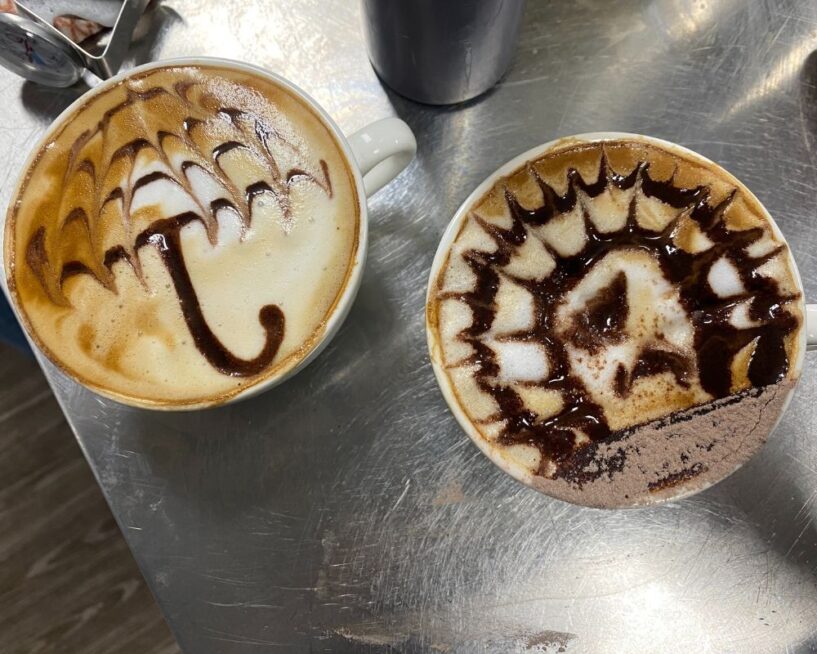
The crema art is the most tedious and my least favorite. For the life of me, I could never get the design to form prominently on the foam. I was so ashamed of my work, I didn’t bother taking a photo.
Free pouring is the hardest to do that even Siva was not able to make a decent latte art using this technique. This leads me to the conclusion that taking a latte art course in this school was pointless as the instructors themselves weren’t very good at it. I would recommend getting the barista basic here, but learn the latte art somewhere else. And that’s my next mission; to take up an advanced latte art course at another school.
Online Assessment
I completed the online assessment on the ABS website, which is part of the requirements to complete this course. You need to get a 100% mark to pass. I had to retake a few questions that I didn’t get right the first time to complete the exam.
Barista Certification
Melbourne, the world’s coffee capital, served as the perfect backdrop for my coffee education. After role plays and an online assessment, I proudly received my Certificate and Statement of Attainment.

Final thoughts
ABS had equipped me with the essential skills to begin my barista journey. The workshop, despite its minor flaws in the latte art segment, was both fun and educational.
For those seeking a comprehensive and affordable barista basic education, I recommend the Australian Barista School. Their passion for coffee and dedication to training will help get you started in your barista journey.